Infections of the 4th Premolar (Carnassial Tooth)
Drs. Foster & Smith, Inc.
Race Foster, DVM
If you look inside your dog’s mouth you will notice one tooth that is much larger than the rest. It is on the upper jaw, about half way back. It is the fourth premolar, sometimes referred to as the carnassial tooth (Figure 1). In wild canines, it is the main tooth used to break up or crush hard material in their diet such as bones or large pieces of meat. Today’s canine diets, even the all-dry ones, really do not require this big "work horse" tooth for the animal to adequately break up his food before swallowing. Still, it is there, and it poses some unique problems for the older dog.
Signs and development of a carnassial tooth abscess
An infection of the 4th premolar is a unique dental problem and has outward signs that are often misunderstood by the owner. The large carnassial tooth has three roots, while most other teeth have only 1 or 2. From 1/2" to 3/4" long, they extend from below the gumline up into the bone of the skull just in front of the eye. There are two in the front portion of the tooth and one in the rear. Carnassial tooth infections actually involve only the roots of the tooth and not the visible exposed portion. The individual root usually involved is the front one that is closest to the skin.
Carnassial tooth infections are caused by bacteria that gain access to the root, either by working their way under the gum at the base of the tooth or by being carried there by the bloodstream. Once the bacteria are in this location between the root and the bone of the skull, the body has a very difficult time ridding itself of the infection. Treatment may control the outward signs but when the medication is discontinued, the infection returns.
The bacteria take up residence on the surface of the root and slowly destroy its attachment to the jaw. In doing so, they deprive the root, and therefore, the tooth, of its blood supply. This eventually leads to death of the affected tissue. Dead tissue in the body is treated the same way as a splinter or other foreign material. In an attempt to isolate and repel the material, the body shunts millions of white blood cells into the area to:
Isolate it from the remaining healthy tissue
Dissolve or break it down so that it can be eliminated as typical cellular waste
Expel it whole from the body
This accumulation of white blood cells at the site of an infection or necrotic material is referred to as pus or an abscess.
In the case of a carnassial tooth, the abscess builds up around the affected root just under the skin below and in front of the eye. The swelling may reach the size of a golf ball. In the case of an abscess, the white blood cells and chemicals that are released have the ability to dissolve the body’s tissue. The weakest portion of the body in this case is the skin, so a small pore soon opens from which pus (or a pink-tinged fluid) will drain. Left alone, this opening will occasionally close but then reopen later as more material accumulates.
Owners often confuse this condition with an eye infection, insect bite, or puncture wound. They may consider it something that, if left alone, will heal on its own. The untreated abscess will, in fact, often spread to 1) the eye causing a very serious and potentially blinding infection or 2) other teeth causing them to be lost also. This is fairly painful for the animal, especially when eating. In dogs that stay outdoors or those with long hair, it may remain unnoticed for a long period of time.
Treatment options
Carnassial abscesses are typically seen in older dogs, especially those over seven years of age. By the time we are able to actually recognize a problem, the initially affected root is often dead. Today, veterinary medicine allows the owner to choose between several methods for handling this problem. There was only one option in the past - pull the tooth along with its roots. The tooth is actually split in half so that the roots can be entirely removed. This is the most difficult tooth to remove correctly and if any portion of the root remains, the problem may continue. Veterinarians today can save the tooth with a procedure similar to the 'root canal.' This can be fairly expensive, but it does save the tooth. Either therapy choice is followed by a long-term use of antibiotics to prevent future problems.
When determining which method to use for your animal, keep in mind 1) the cost, 2) the dog’s dental health and overall health, and 3) the effect the loss of the tooth would have on your pet. In most cases, a dog does just fine without this particular tooth and is able to eat any type of food you may choose to give him.
Sunday, March 28, 2010

Saturday, March 27, 2010
Healing nicely
Brady's gum is healing nicely and he is doing well after having his tooth extracted.
He is feeling well and doing his normal activities.
He is feeling well and doing his normal activities.
Brady's tooth extraction
On Monday morning, March 22nd, Brady and I were off to the vet to have his tooth looked at.
Since Dr. Slayman was already performing surgery on other patients that morning, Dr. Peace took a look at his tooth. It was evident that there was an abscess and the tooth needed to be extracted. Dr. Peace gave Brady an injection to 'make him happy' while we waited.
Shortly thereafter, he was taken away to have the procedure done by Dr. Slayman. The extraction went well, though unfortunately, there was a bit of bad news. Note: the carnassial tooth is very large and has three root tips. The tooth must be broken in half to be removed. When Dr. Slayman was removing the healthy part of the tooth, two of the root tips broke off and were left in his gum. The good news is that those 2 root tips were healthy, so leaving them in the gum shouldn't cause any problems. The infected part of the tooth and the infected root tip came out with any trouble at all. Dr. Slayman advised me to keep an eye on his face for signs of infection just in case; but ultimately did not anticipate any problems to develop.
The extraction site was left open, not sutured, to allow for drainage. Brady will be on an antibiotic, Clindamycin, 150mg, twice daily, for 10 days.
Since Dr. Slayman was already performing surgery on other patients that morning, Dr. Peace took a look at his tooth. It was evident that there was an abscess and the tooth needed to be extracted. Dr. Peace gave Brady an injection to 'make him happy' while we waited.
Shortly thereafter, he was taken away to have the procedure done by Dr. Slayman. The extraction went well, though unfortunately, there was a bit of bad news. Note: the carnassial tooth is very large and has three root tips. The tooth must be broken in half to be removed. When Dr. Slayman was removing the healthy part of the tooth, two of the root tips broke off and were left in his gum. The good news is that those 2 root tips were healthy, so leaving them in the gum shouldn't cause any problems. The infected part of the tooth and the infected root tip came out with any trouble at all. Dr. Slayman advised me to keep an eye on his face for signs of infection just in case; but ultimately did not anticipate any problems to develop.
The extraction site was left open, not sutured, to allow for drainage. Brady will be on an antibiotic, Clindamycin, 150mg, twice daily, for 10 days.
Brady's swollen cheek
On Friday night, March 19th, I noticed that the right side of Brady's face was swollen. Although he was eating just fine, playing as normal, and didn't seem to be in any pain, something was clearly going on. After looking inside his mouth, I discovered that the right upper carnassial (4th premolar) tooth was more than likely the culprit. The gum line above the tooth was inflamed and would bleed a little with gentle pressure on the gum.
I called the vet's office the following Saturday morning and at Dr. Slayman's recommendation, I decided to wait until Monday morning to bring Brady in. It was evident that it wasn't bothering him at the time and so it wasn't considered an emergency. If the tooth needed to be extracted, then waiting until Monday morning shouldn't be a problem.
I called the vet's office the following Saturday morning and at Dr. Slayman's recommendation, I decided to wait until Monday morning to bring Brady in. It was evident that it wasn't bothering him at the time and so it wasn't considered an emergency. If the tooth needed to be extracted, then waiting until Monday morning shouldn't be a problem.
Thursday, March 18, 2010
Things We Can Learn From Our Dogs
Never pass up the opportunity to go for a joy ride.
Allow the experience of fresh air in and the wind
in your face to be pure ecstasy.
When loved ones come home, always run to greet them.
When someone is having a bad day, be silent,
sit close and nuzzle them gently.
When it's in your best interest, practice obedience,
Let others know when they've invaded your territory.
Take naps and stretch before rising,
Run, romp and play daily.
Eat with gusto and enthusiasm.
Be loyal.
Never pretend to be something you're not.
If what you want lies buried, dig until you find it.
Thrive on attention, and let people touch you.
Avoid biting when a simple growl will do.
On hot days, drink lots of water and
lie under a shady tree.
When you're happy, dance around
and wag your entire body.
No matter how often you're scolded,
don't buy into the guilt thing, and pout...
run right back and make friends.
Deight in the simple joy of
a long walk.
Allow the experience of fresh air in and the wind
in your face to be pure ecstasy.
When loved ones come home, always run to greet them.
When someone is having a bad day, be silent,
sit close and nuzzle them gently.
When it's in your best interest, practice obedience,
Let others know when they've invaded your territory.
Take naps and stretch before rising,
Run, romp and play daily.
Eat with gusto and enthusiasm.
Be loyal.
Never pretend to be something you're not.
If what you want lies buried, dig until you find it.
Thrive on attention, and let people touch you.
Avoid biting when a simple growl will do.
On hot days, drink lots of water and
lie under a shady tree.
When you're happy, dance around
and wag your entire body.
No matter how often you're scolded,
don't buy into the guilt thing, and pout...
run right back and make friends.
Deight in the simple joy of
a long walk.
Enjoying beautiful days
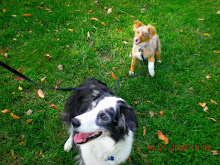
Brady continues to do well; things are looking good. We've been spending some wonderful time outside the past few days playing ball, going for walks, and sometimes just sitting. The weather has been just gorgeous. Cool mornings giving way to warm afternoons and a big bright blue sky.
All of our dogs love being outside and especially on spring-like days like we've been blessed with recently (although, in all honesty, they will take any kind of weather). Whether running and chasing each other, rolling in the grass, playing ball, or whatever it may be, they go at it with gusto. Come to think of it, that's good advice to live by: enjoy each and every moment and give it your all. Remember to run, romp and play daily.
All of our dogs love being outside and especially on spring-like days like we've been blessed with recently (although, in all honesty, they will take any kind of weather). Whether running and chasing each other, rolling in the grass, playing ball, or whatever it may be, they go at it with gusto. Come to think of it, that's good advice to live by: enjoy each and every moment and give it your all. Remember to run, romp and play daily.
Saturday, March 13, 2010
Keppra/Levetiracetam (generic)
Keppra: Keppra is an excellent long term anti convulsive treatment that has the added benefit of being associated with an exceptionally low incidence of toxicity. The draw back of Keppra at this time remains its high cost. Therefore, in most cases, Keppra is reserved for use in dogs as an additional anticonvulsant to be used in cases where seizure suppression has become refractory to doses of phenobarbital and potassium bromide that are approaching the maximum. It also may be a better choice than potassium bromide for additional anticonvulsant therapy for cats in cases where phenobarbital alone does not adequately control seizures.
Subscribe to:
Posts (Atom)